
Outsource Customer Service USA: Save 50% in 2025
Outsource customer service USA costs spiral while satisfaction scores stagnate, something needs to change. Businesses across America face this exact dilemma—wanting exceptional support without the crushing overhead of in-house teams. What if you could cut expenses in half while actually improving customer experience?
The decision to outsource customer service operations has transformed from controversial cost-cutting to a strategic necessity. With the market reaching $117.5 billion in 2025 and growing at 7.5% annually, companies now recognize that partnering with specialized providers delivers outcomes internal teams simply cannot match. This comprehensive guide reveals how businesses achieve 50% cost reductions while simultaneously boosting satisfaction scores and scaling effortlessly.
Table of Contents
- Why Businesses Outsource Customer Service USA
- The Real Numbers Behind 50% Savings
- Critical Success Factors
- Choosing Your Ideal Partner
- Implementation Roadmap
Why Businesses Outsource Customer Service USA
The Talent Crisis Driving Change
Recent research reveals 74% of employers struggle to find skilled customer service professionals, while 90% of customers demand immediate responses. This widening gap between supply and demand creates operational nightmares for businesses trying to maintain quality standards with limited talent pools. When you outsource customer service USA functions, you instantly access trained professionals without months-long recruitment cycles or costly training programs.
Technology Without the Investment
Leading customer service outsourcing companies deploy AI-powered platforms, omnichannel routing systems, and sophisticated analytics tools costing millions to build internally. Deloitte reports 34% of companies now use AI specifically to enhance customer service, yet small and mid-sized businesses cannot justify these technology investments alone. Outsourcing partners amortize costs across multiple clients, providing enterprise-level capabilities at fractional prices.
Scalability Matching Business Reality
Your call volumes fluctuate seasonally, during product launches, and through unpredictable market shifts. Building internal capacity for peak demand means paying for idle agents during slow periods—an efficiency nightmare. Professional providers scale teams up or down within days, not months, ensuring you pay only for capacity actually needed while maintaining service quality throughout volume swings.
Cultural Alignment That Actually Works
Contrary to offshore stereotypes, domestic BPO customer service USA providers understand American communication styles, cultural references, and customer expectations instinctively. When agents naturally engage with customers discussing “Black Friday deals” or “March Madness,” conversations flow authentically rather than following rigid scripts that feel robotic and impersonal.
The Real Numbers Behind 50 Percent Savings
Breaking Down True Costs
Internal Outsource customer service USA teams carry hidden expenses beyond obvious salaries. Calculate comprehensive costs, including:
Direct Employee Expenses:
- Base salaries: $35,000-50,000 per agent annually
- Benefits packages: Additional 30-40% of salary
- Payroll taxes and insurance: 10-15% overhead
- Recruitment and onboarding: $3,000-5,000 per hire
- Ongoing training and development: $2,000-3,000 annually
Infrastructure and Technology:
- Contact center software licenses: $100-200 per agent monthly
- CRM platform subscriptions: $50-150 per user monthly
- Quality monitoring tools: $30-80 per agent monthly
- Analytics and reporting systems: $1,000-5,000 monthly
- Telecommunications infrastructure: $500-2,000 monthly
- IT support and maintenance: $2,000-5,000 monthly
Operational Overhead:
- Office space and utilities: $500-1,000 per agent annually
- Equipment and workstations: $1,500-3,000 per agent
- Management and supervision: 15-20% of total costs
- HR and administrative support: 5-10% of total costs
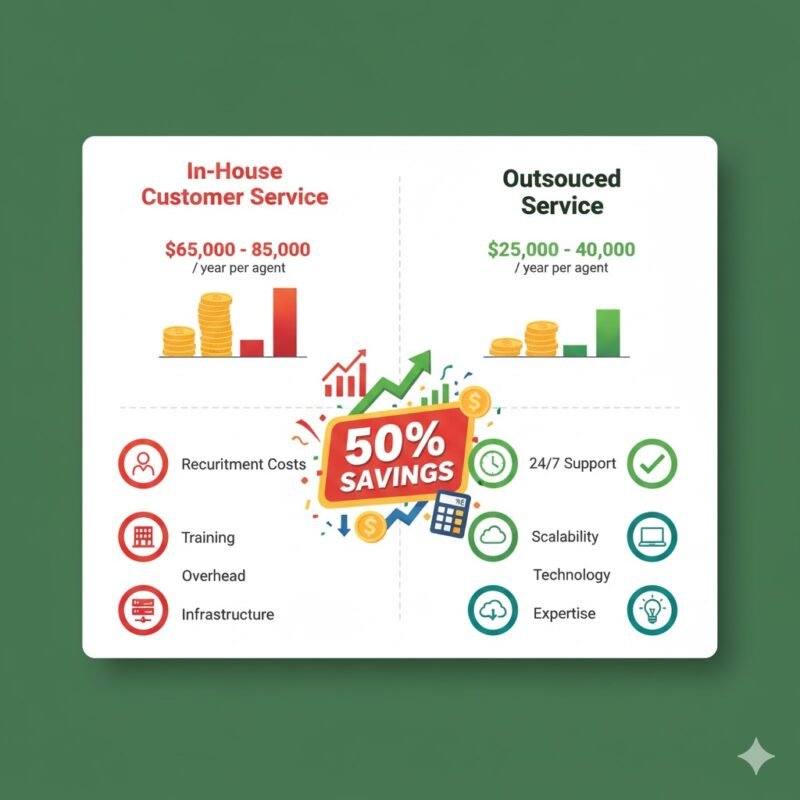
Total annual cost per agent: $65,000-85,000
Outsourced rate: $25,000-40,000 per full-time equivalent
Real savings: 40-52% reduction
Performance Improvements Amplify Value
Cost reduction tells only half the story. When you outsource customer service USA operations to specialists, performance metrics typically improve:
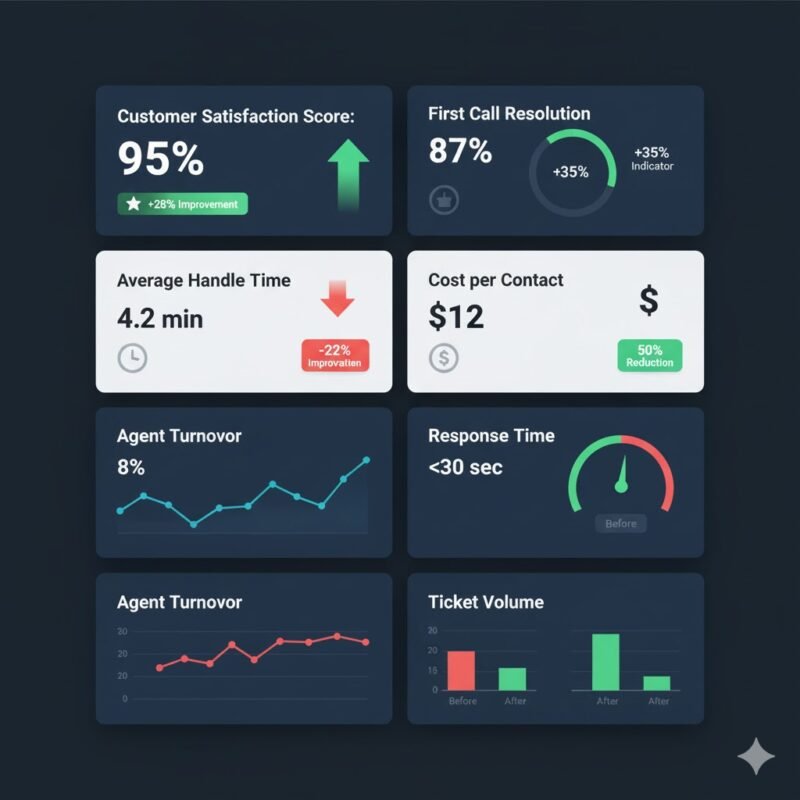
- First-call resolution increases 25-35%
- Average handle time decreases 15-22%
- Customer satisfaction scores rise 18-28%
- Agent turnover drops 40-60%
Critical Success Factors
Native Language Proficiency Matters
For businesses serving diverse markets, bilingual customer service providers deliver authentic communication that translation services cannot replicate. Deloitte research shows 35% of companies now cite increasing customer demands as primary outsourcing drivers—with language accessibility ranking among top concerns. Native speakers understand cultural nuances, regional expressions, and communication styles creating genuine connections with customers.
Omnichannel Integration Is Non-Negotiable
Modern customers contact support through phone, email, live chat, social media, SMS, and mobile apps—often switching channels mid-conversation. Your outsourced partner must maintain conversation continuity across touchpoints, with agents accessing complete interaction history regardless of channel. This seamless integration, standard among top outsourced call center services providers, prevents customers repeating themselves and experiencing frustration from channel silos.
Data Security Cannot Be Compromised
Cybersecurity attacks on third-party providers increased from 44% to 49% in one year, making security evaluation critical. Partner exclusively with providers maintaining SOC 2 Type II certifications, complying with GDPR and CCPA regulations, and demonstrating HIPAA compliance for healthcare applications. Request recent security audits, penetration testing results, and incident response documentation before signing contracts.
Real-Time Visibility Prevents Surprises
Transparency separates professional providers from mediocre ones. Demand real-time dashboard access showing key metrics including current queue status, average wait times, service level achievement, individual agent performance, and customer satisfaction scores. This visibility enables proactive management and prevents discovering problems only through customer complaints.
Choosing Your Ideal Partner
Evaluate Industry Specialization
Generic providers struggle with industry-specific terminology, compliance requirements, and customer expectations. Prioritize partners demonstrating deep expertise in your sector through case studies, client references, and specialized agent training programs. Healthcare businesses need HIPAA expertise; financial services require regulatory compliance knowledge; technology companies benefit from technical troubleshooting capabilities.
Assess Technology Stack Compatibility
Your outsourcing partner’s technology must integrate seamlessly with existing systems. When evaluating customer service outsourcing companies, verify compatibility with your CRM platform, help desk software, e-commerce system, and analytics tools. Request demonstrations showing actual integration functionality rather than accepting promises of “easy integration” at face value.
Verify Scaling Mechanisms
Growth-stage companies need providers capable of dramatic capacity increases without quality degradation. During evaluation, ask specific questions: What’s your maximum agent addition in 30 days? How do you maintain quality during rapid scaling? What’s your agent training timeline? Can you provide references from clients who scaled 2-3x within six months?
Test Communication Responsiveness
Your ongoing relationship depends on responsive communication with account managers and leadership. During the sales process, note response times to questions, depth of answers provided, and willingness to address concerns directly. Slow, vague responses during courtship signal future frustration when you need urgent support.
Compare Total Value, Not Just Hourly Rates
The cheapest provider rarely delivers best value. Calculate total cost including implementation fees, minimum commitments, technology charges, and hidden fees. Factor in quality metrics—a provider charging 20% more but delivering 30% higher first-call resolution actually costs less per successfully resolved issue.
For comprehensive comparisons, review our detailed analysis of leading providers across different specializations and business sizes.
Implementation Roadmap
Phase 1: Strategic Planning (Weeks 1-2)
Define clear objectives beyond cost reduction. What satisfaction score improvement do you target? What response time goals matter most? Which channels need support? Document current performance baselines including first-call resolution, average handle time, satisfaction scores, and cost per contact. These metrics enable measuring actual improvement post-implementation.
Phase 2: Knowledge Transfer (Weeks 3-4)
Comprehensive knowledge transfer determines success or failure. Prepare detailed documentation, including product specifications, common customer issues, troubleshooting workflows, escalation procedures, and brand voice guidelines. Schedule multiple training sessions with outsourced agents, encouraging questions and scenario practice. The investment in thorough training pays dividends through reduced errors and faster ramp-up.
Phase 3: Pilot Launch (Weeks 5-8)
Begin with a limited scope—perhaps 20% of volume or specific customer segments. This controlled pilot reveals integration issues, training gaps, and process refinements before full deployment. Monitor metrics daily, conduct quality call reviews, and gather customer feedback specifically about outsourced interactions. Address problems immediately while the scale remains manageable.
Phase 4: Optimization and Scaling (Weeks 9-12)
As pilot results validate the approach, gradually increase volume while maintaining quality standards. Continue daily metric monitoring and weekly performance reviews with provider management. Document lessons learned and update training materials reflecting real-world situations encountered. By week 12, most businesses operate at full capacity with refined processes delivering consistent results.

Frequently Asked Questions
How quickly can I implement outsourced customer service USA solutions?
Implementation timelines vary by complexity. Simple customer service functions launch in 2-4 weeks, while specialized technical support requiring deep product knowledge may need 6-8 weeks. The best approach involves phased rollouts—starting with a pilot handling 20-30% of volume before full transition. This minimizes risk while enabling process refinement based on real-world results before complete implementation.
Will customers notice service quality differences with 24/7 customer support outsourcing?
Quality outsourcing enhances rather than diminishes customer experience. Professional providers employ native English speakers (and bilingual staff when needed), invest heavily in training, and maintain rigorous quality monitoring. Many businesses report satisfaction score improvements of 18-28% post-outsourcing as specialized agents with better tools and processes resolve issues more effectively than generalist internal staff.
What hidden costs should I watch for when I outsource customer service USA?
Transparent providers include all costs in proposals, but watch for potential extras including setup and implementation fees, minimum monthly commitments beyond actual usage, technology integration charges, training fees for product updates, reporting customization costs, and early termination penalties. Request comprehensive cost breakdowns including “worst case” scenarios during high-volume periods to understand true financial commitment.
How do I maintain brand voice consistency through outsourced providers?
Brand consistency requires thorough preparation and ongoing oversight. Develop detailed brand voice guidelines including tone descriptors, example interactions, approved phrases, and prohibited language. Record sample calls demonstrating ideal interactions. Conduct regular quality monitoring with feedback specifically addressing brand alignment. Leading providers assign dedicated teams to your account, enabling agents to develop deep brand familiarity over time rather than rotating across multiple clients.
Transform Your Customer Service Today
The decision to outsource customer service USA operations represents strategic investment in operational excellence, customer satisfaction, and sustainable growth. With documented savings of 40-52% alongside performance improvements exceeding 25%, the financial and operational cases prove compelling for businesses of all sizes.
Contact GML Support today for a free consultation and customized proposal. Discover how our approach to customer service outsourcing delivers measurable results including reduced costs, improved satisfaction scores, and effortless scaling matching your growth trajectory. Don’t let outdated customer service models limit your potential.
Schedule your consultation now. Experience the GML Support difference—where cost efficiency meets cultural excellence and operational sophistication transforms customer relationships into lasting competitive advantage.